
AI adoption in manufacturing and distribution starts with the knowledge behind the work

In short. Before an AI agent can handle customer orders, it needs more than access to the ERP. It needs the rules, context and exceptions your experienced people apply without thinking, each with a source, a scope and an owner. And it needs a clear line between what it may do alone and what goes to a person. Start with one real workflow:
- Choose a job with a clear finish.
- Capture why each check exists.
- Assign knowledge, decisions and execution separately.
- Test the handoffs as carefully as the routine cases.
- Turn corrections into knowledge the business can maintain.
- Expand according to the gaps in completed work.
If you run operations or customer service at a distributor or manufacturer, you have probably been asked some version of the same question this year: what is our AI plan?
Maybe you have already run a pilot. It reads the emails and pulls the line items. And the hard orders still land on the same three or four senior people everyone calls when the answer is unclear. The order desk still grows one hire at a time, and every new hire still has to learn what those people know.
That is not a model problem. The AI had access to the data. It did not have the knowledge behind the work.
Consider an illustrative order at a building materials distributor. A customer emails a list using their own product descriptions. One item is unavailable. A previous message says the site cannot accept partial deliveries. An alternative is in stock, but someone needs to confirm that it will work for this application.

The ERP, SAP or otherwise, provides customer records, products, pricing, and inventory. Completing the order also depends on instructions in correspondence, product judgment, and an understanding of what the customer has agreed to.
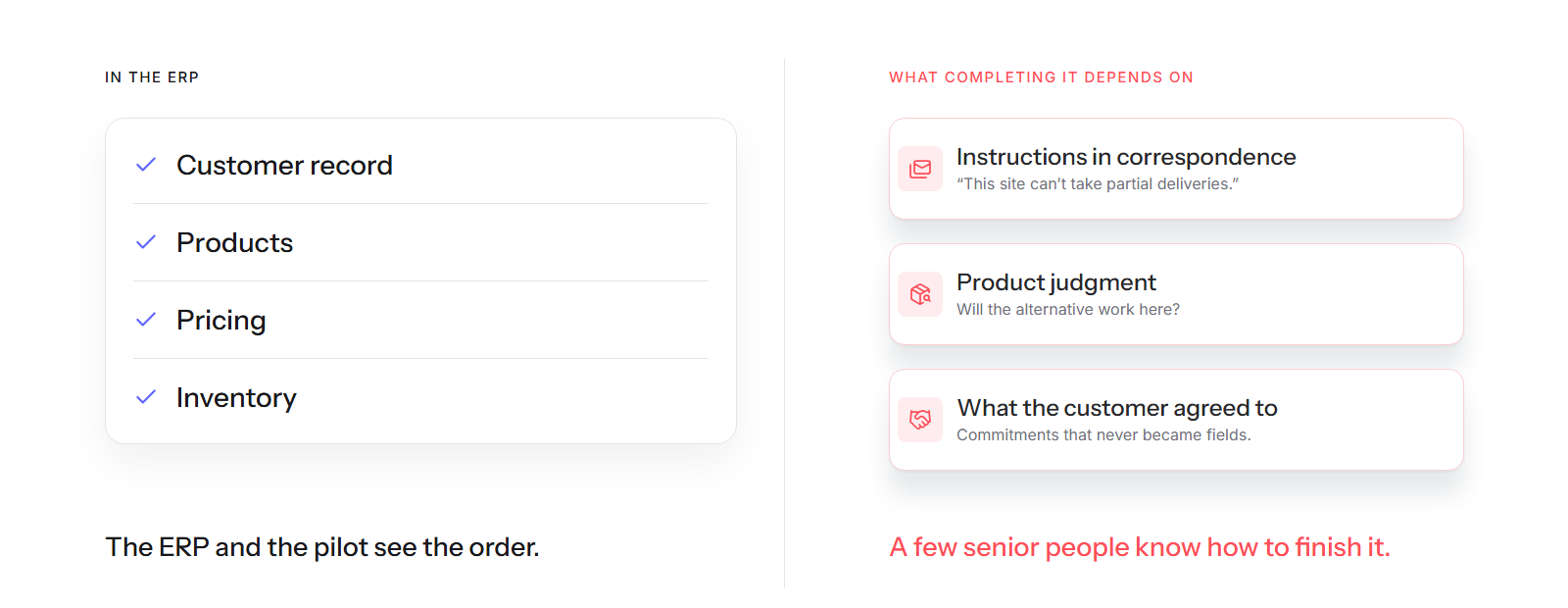
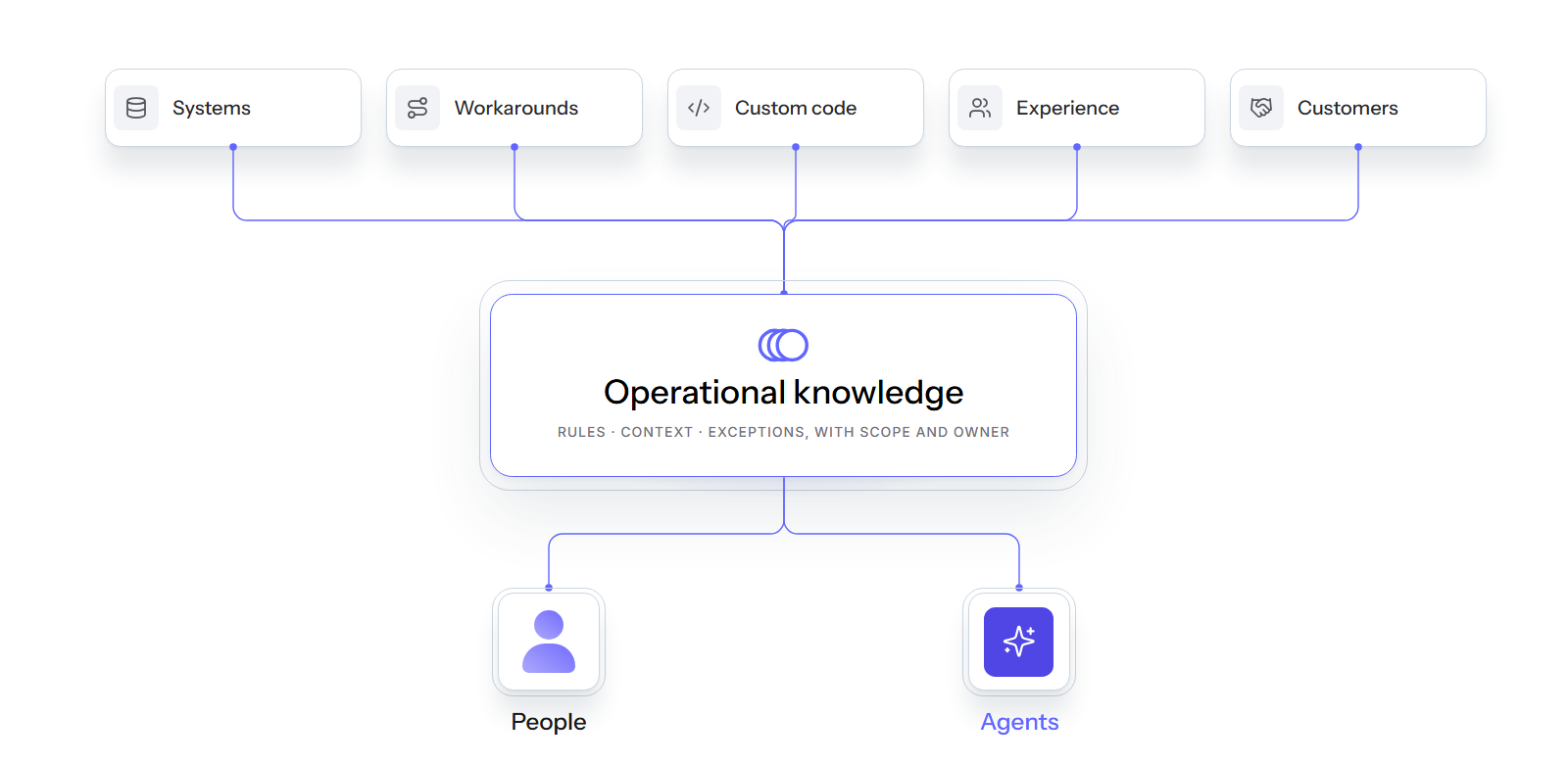
An experienced order desk employee connects these pieces almost without thinking. That is tribal knowledge: rarely written down, carried by a few people, and at risk every time one of them leaves. An agent can have access to every record and still be missing what it takes to act responsibly. It needs a way to find the relevant knowledge, understand where it applies, and act within the authority the business has given it.
That is where AI adoption becomes an operational design problem. Before delegating the work, the business has to understand what the work depends on.
Separate the knowledge from the way it is carried today
A workaround can contain an important business rule. A piece of custom code can enforce a condition whose original purpose has become hard to find. A customer relationship can carry commitments that never became formal instructions.
Treating these as one automation problem creates two risks. You can reproduce a cumbersome process because that is how the knowledge happens to be carried. Or you can remove a step and lose the reason it existed. (More on this in our piece on workarounds.)
In the order example, an employee might call an account manager whenever an item is unavailable. Before automating or removing that call, ask what it accomplishes. Does the account manager check product suitability, obtain permission for a split shipment, or protect a promise made to the customer? Each answer implies a different responsibility.
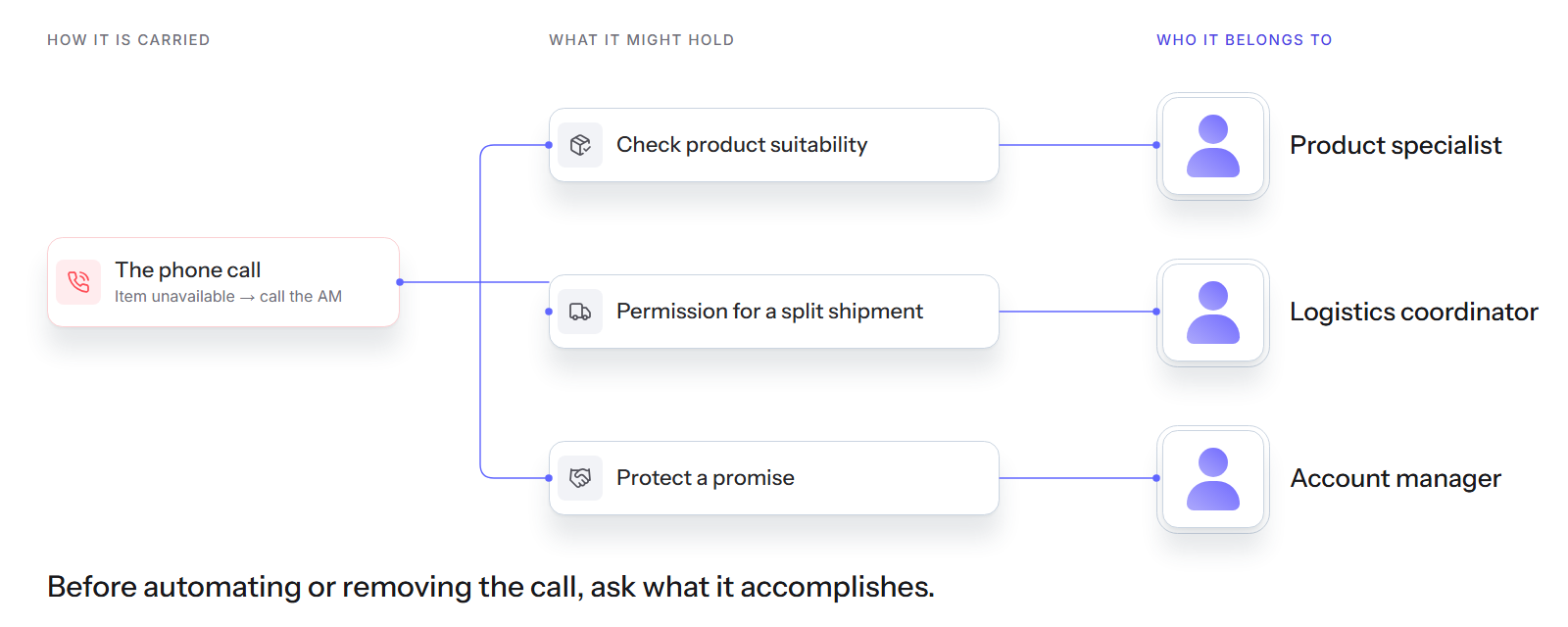
The business may be able to change how the work gets done while preserving the judgment or commitment behind it.
At Frontleap, we believe operational knowledge should become a lasting asset the business owns, available to people and agents at the moment of work. It should help the business decide who can handle each part of the work and under what conditions.
The goal is not to maximize the share of work performed by AI. It is to increase what the operation can do, and what its people are free to contribute. Here is a practical approach for getting there, one workflow at a time. It is also a plan you can bring to your leadership team: it starts small, it keeps your ERP in place, and it protects what your people know.
1. Choose a job with a clear finish
Start with a bounded workflow, such as preparing an emailed order for review and entry into the ERP.
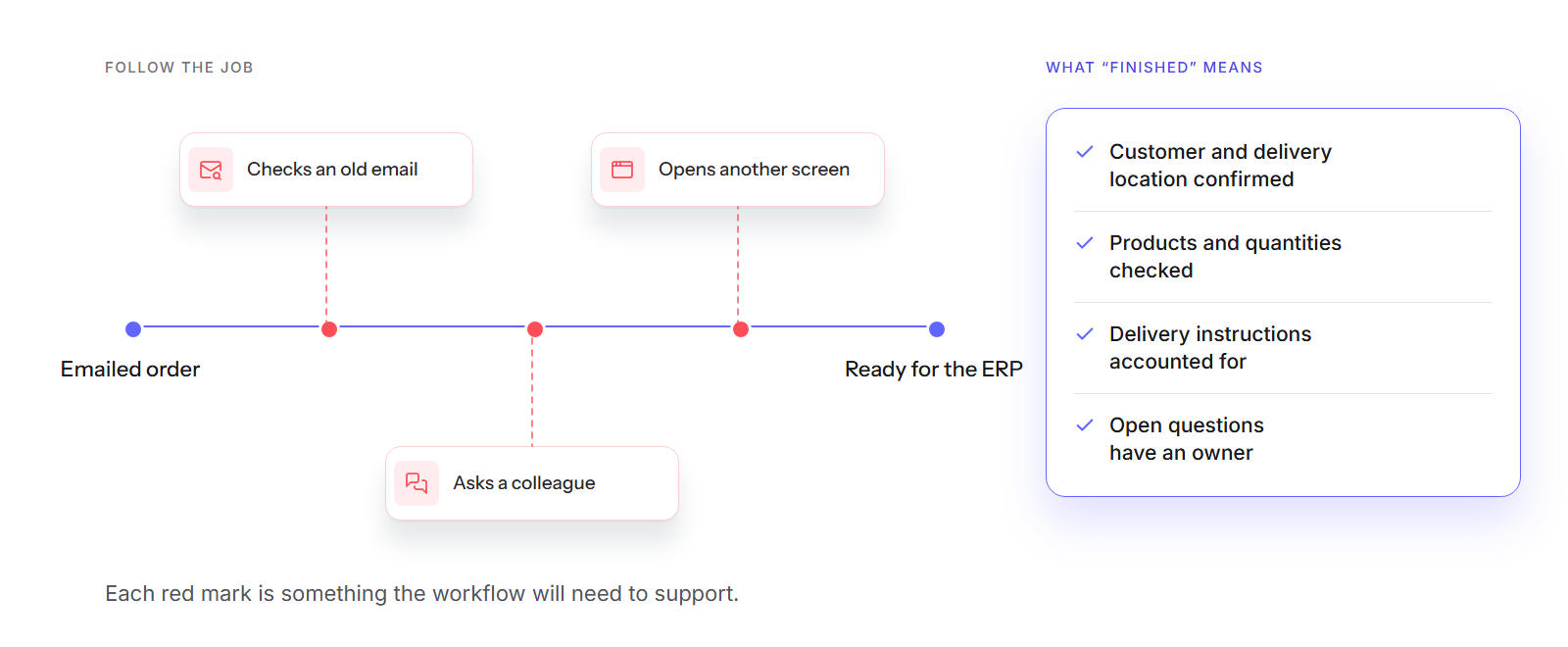
Define what finished means:
- the customer and delivery location are confirmed;
- products and quantities are checked;
- delivery instructions are accounted for;
- unresolved questions have an owner.
Follow employees through the job. Record where they leave the system, consult a colleague, or check an earlier conversation. Those moments help reveal what the workflow needs to support.
2. Capture why each check exists
Sit with your most experienced people and ask why they paused. What made the product match questionable? Why did they check an old email? What would have gone wrong if they had continued? This is where tribal knowledge starts to become something the business owns.
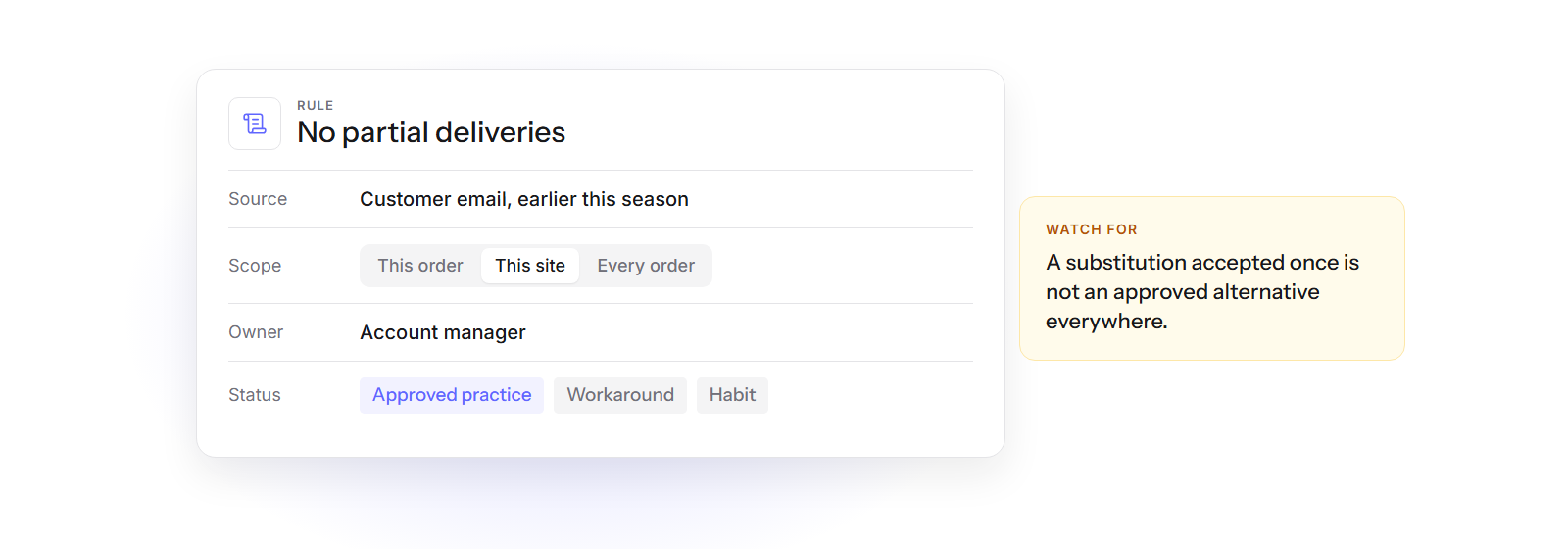
For each instruction or rule, capture its source, scope, and owner. A delivery restriction might apply to one order, one construction site, or every order from that customer. A substitution accepted once does not automatically become an approved alternative everywhere.
Have the appropriate owner distinguish an approved practice from a temporary workaround or an individual habit. This is also the moment to question rules that no longer serve a purpose.
3. Assign knowledge, decisions, and execution separately
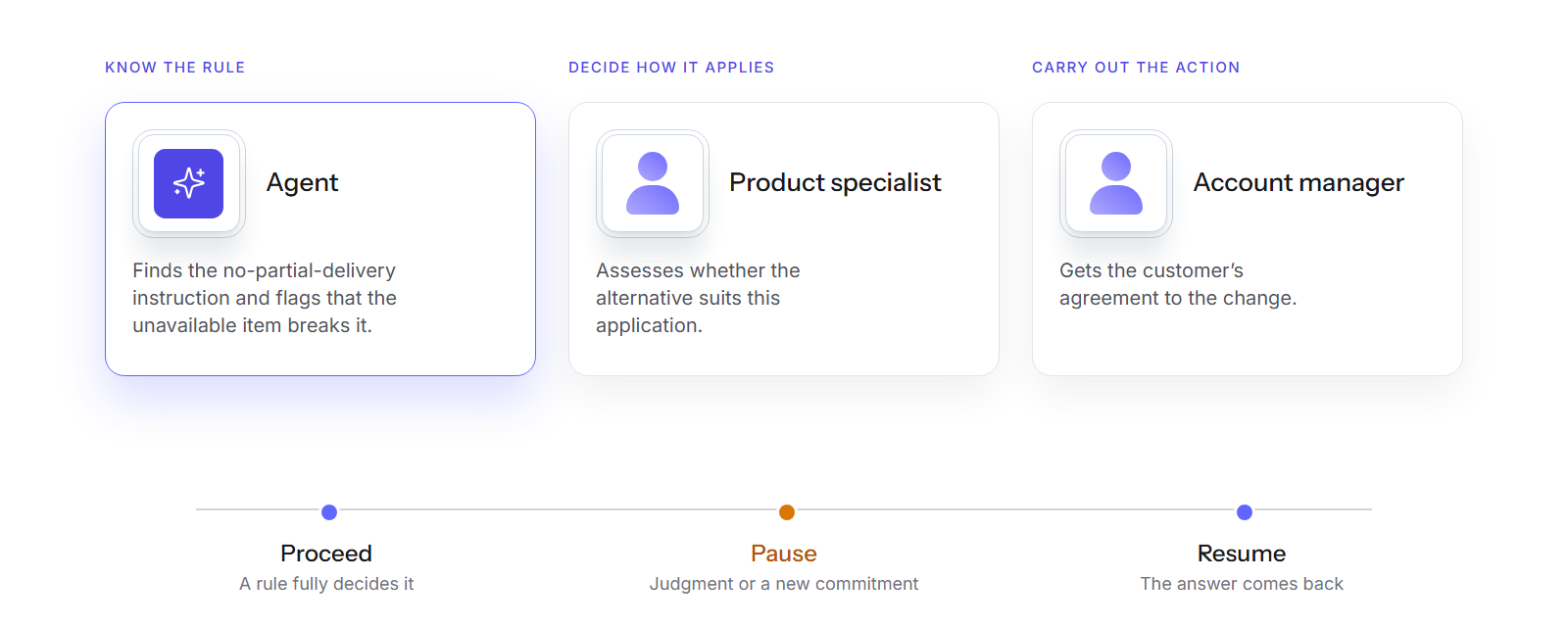
Knowing a rule, deciding how it applies, and carrying out an action are different responsibilities. Assign each deliberately.
In our example:
- an agent could identify the no-partial-delivery instruction and flag that an unavailable item prevents the order from meeting it;
- a qualified product specialist could assess whether the alternative suits the application;
- someone with the appropriate authority could then obtain the customer’s agreement to a change.
Where an approved rule fully determines the next action, the business may authorize an agent to carry it out. Where the situation calls for judgment, negotiation, or a commitment outside that authority, route it to the appropriate person with the relevant context.
Specify what can proceed, what must pause, and what allows the work to resume. Responsibility should follow the knowledge and authority required for that particular decision.
None of this takes the specialist out of the work. Their judgment is part of what the business sells. The human is not the fallback; the human is part of the operating model.
4. Test the handoffs as carefully as the routine cases
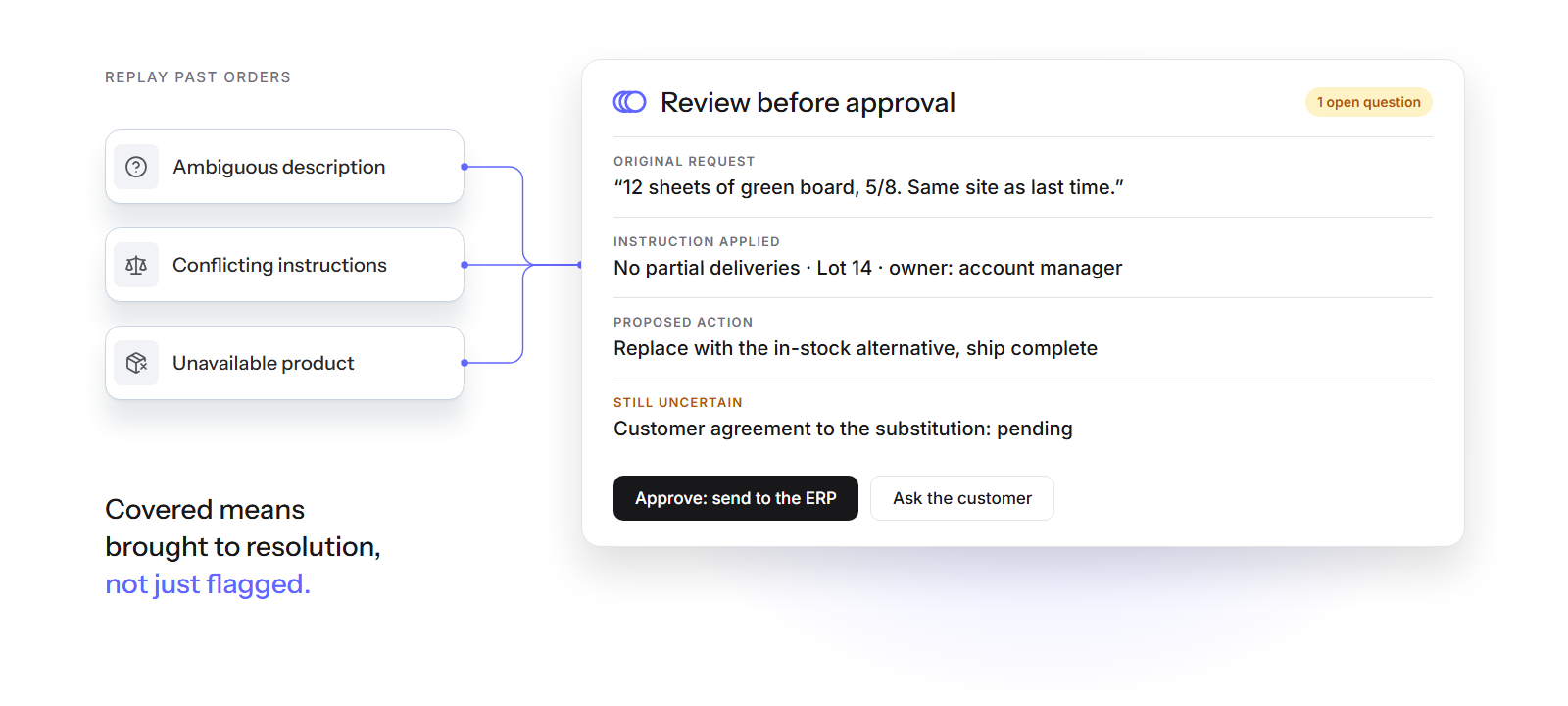
Use representative past orders to test the workflow, including cases with ambiguous descriptions, conflicting instructions, and unavailable products.
Check three things:
- it recognizes the uncertainty;
- it finds the relevant rule;
- it sends the unresolved question to someone who can answer it.
Then test what happens after the answer comes back.
A reviewer should be able to see the original request, the instruction being applied, the proposed action, and what remains uncertain. They should understand what their approval will cause.
An exception is covered when the workflow can bring it to resolution. A flag that leaves an employee to reconstruct the situation elsewhere still leaves work to do.
5. Turn corrections into knowledge the business can maintain
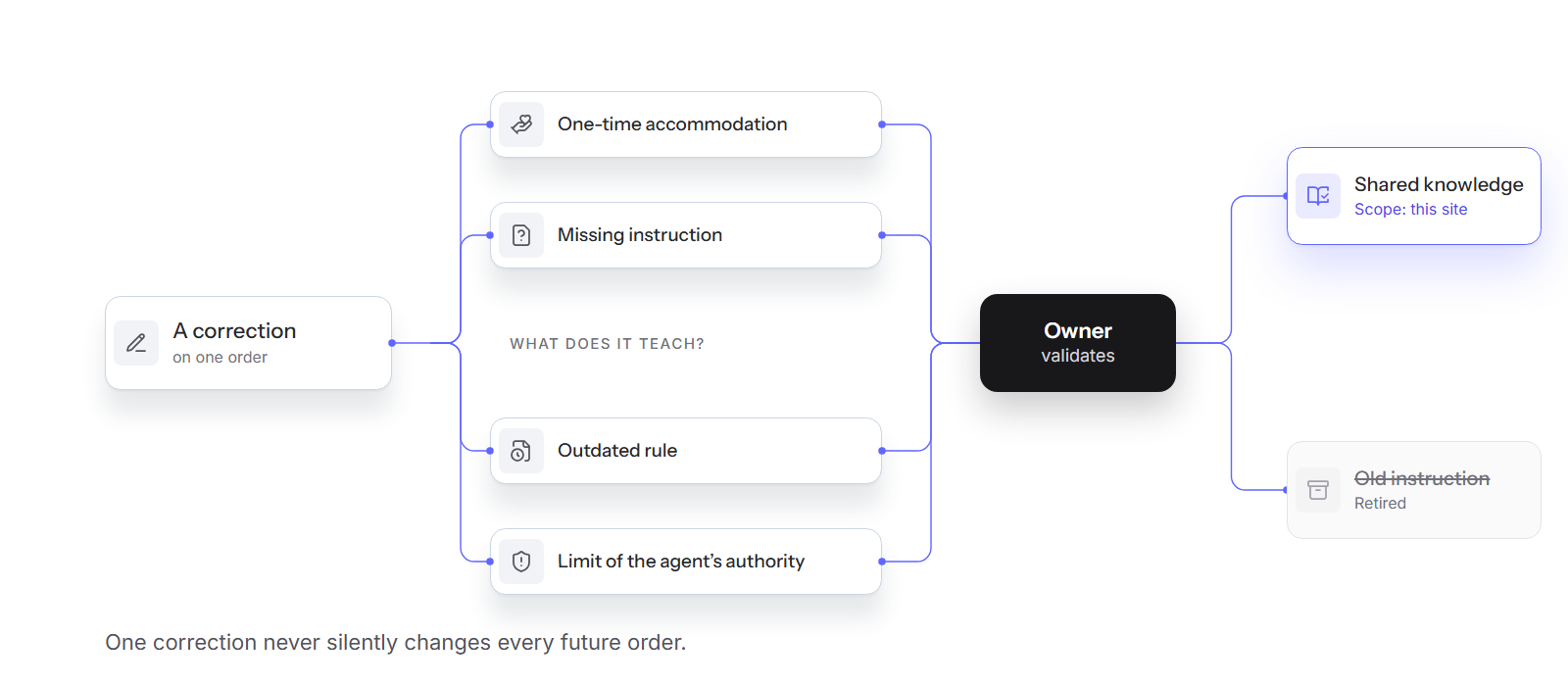
When someone corrects an order, ask what the correction teaches. Was this:
- a one-time customer accommodation;
- a missing instruction;
- an outdated rule;
- or a limit in the agent’s authority?
Give an owner responsibility for deciding which changes become shared knowledge. Record where they apply and retire the instructions they replace.
A correction on one order should not silently change the treatment of every future order. Capturing an answer without its scope just makes the wrong answer easier to repeat. Once validated for broader use, the learning should help the next employee or agent facing the same situation.
6. Expand according to the gaps in completed work
Measure whether the chosen workflow helps the team reach correct outcomes. Compare similar orders and track preparation time, corrections, unresolved questions, and errors discovered afterward.
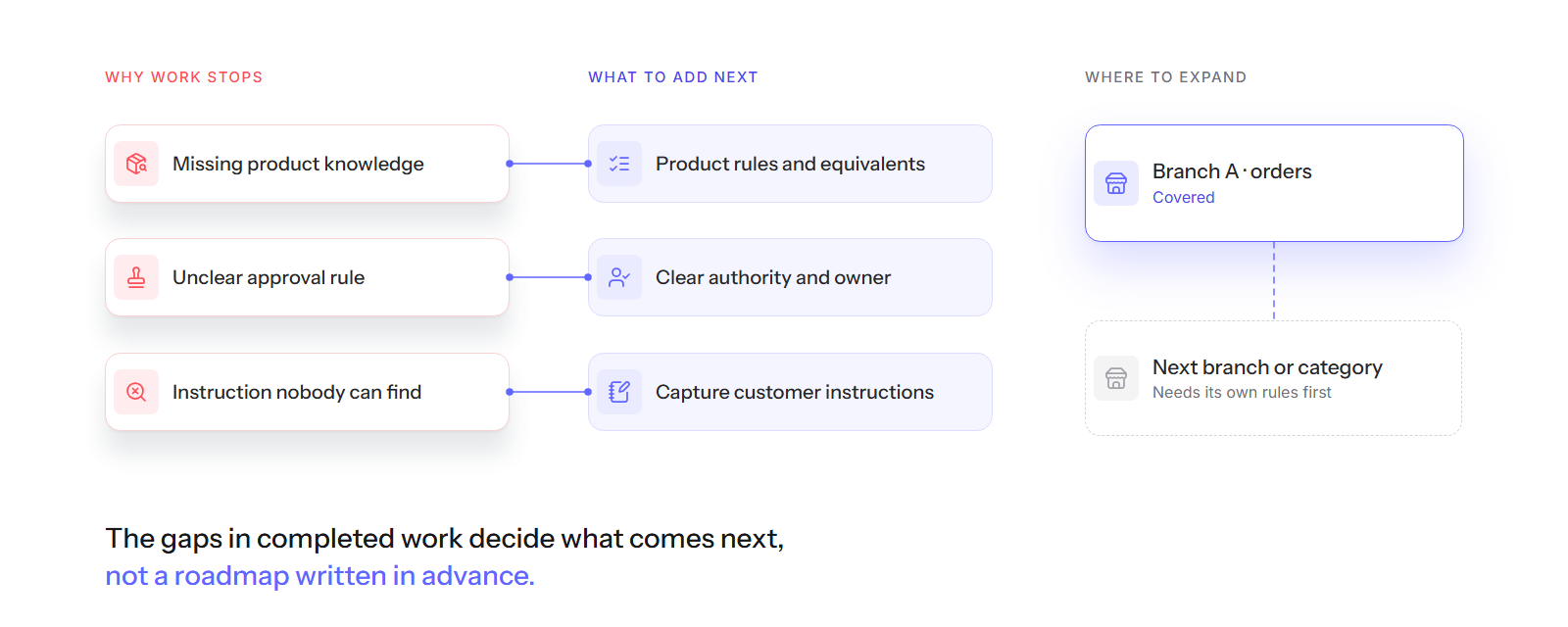
Record why work stops. Missing product knowledge calls for a different improvement than an unclear approval rule or a customer instruction nobody can locate.
Use those gaps to choose what to add next. A workflow that handles one branch’s orders may need different rules or responsibilities before it can support another branch or product category.
A complete example, from email to SAP-ready order
Illustrative example: the customer, products and quantities are invented.
- The email. Martin Roy writes to the order desk: 40 two-by-six, “the usual length”, 12 sheets of green board 5/8, 6 boxes of deck screws, “same site as last time”.
- The ambiguous product. “The usual length” is not a product code, and the green board 5/8 is out of stock at the branch that serves Lot 14.
- The context retrieved. The agent finds Martin’s last three orders for Lot 14, all 16-foot two-by-six, and an earlier email saying the site cannot take partial deliveries. It also finds an in-stock alternative to the green board.
- The CSR’s decision. The agent can match the two-by-six on its own: the rule is clear. The substitution is different, because it changes what the customer receives. The customer service representative checks that the alternative suits the application and calls Martin, who agrees.
- The order, ready for SAP. Customer, ship-to Lot 14, 40 two-by-six 16 ft, 12 sheets of the approved alternative, 6 boxes of deck screws, delivered complete. The substitution is recorded with its reason and its scope: this order, not every future one.
Make the knowledge reusable, then reconsider who does the work
A useful starting point for AI adoption is one real order and a close look at everything required to complete it.
Identify the knowledge in the systems, the workarounds, the custom code, the employees’ experience, and the customer relationship. Understand what each piece contributes. Then decide what to preserve, what to change, and which responsibilities belong with a person or an agent.
For your next workflow, ask: what must be understood, who has the authority to decide, and what can be delegated once those conditions are clear?
This is what we are building at Frontleap: AI order management for manufacturers and distributors on SAP, built as an execution layer that runs alongside the ERP. It captures the operational knowledge that lives nowhere in your systems and gives people and AI one place to act on it together. We start with orders, because that is where the connection to the customer is immediate (see the Order Desk). I explain the conviction behind it in our manifesto.
Frequently asked questions
How do you reduce the order desk’s dependence on a few senior people?
Capture what they know while the work happens, not in a manual. Follow them through one real workflow and note every time they leave the system. Record each rule they apply with its source, scope and owner. The knowledge then stays with the business when people move on, and new hires can draw on it from day one.
How do you keep order knowledge current when catalogues, prices and teams change?
Give every rule an owner. When someone corrects an order, the owner decides whether the correction becomes shared knowledge, where it applies, and which old instruction it retires. A correction on one order should never silently change every future order.
What should an AI agent handle alone, and what should stay with a person?
An agent can act where an approved rule fully determines the next step. Judgment, negotiation and commitments beyond its authority go to the right person, with the context attached. Write down what proceeds, what pauses and what allows the work to resume before anything is delegated.
Scope your first workflow with us
Bring one real order workflow. Together we will: define what finished means; map where the work leaves the system; sort what an agent could handle on its own from what stays with your people.
Scope a workflowAuthors

Read more


Frequently asked questions
What is Frontleap, exactly?
Frontleap is an AI-powered order management platform built for manufacturers and distributors on SAP. It adds an execution layer on top of the ERP to simplify and automate order work. Your ERP stays the system of record; Frontleap is where the work actually happens — order entry, product search, inventory lookup, document access — in an interface built for the people doing it. Nothing is duplicated and nothing is replaced: we hold the last 20% of the ERP, the part your teams currently handle with spreadsheets, email and workarounds.
Do we need to replace or modify our ERP to use Frontleap?
No. Frontleap runs alongside your existing ERP, without modification to your core systems. Your ERP keeps operating exactly as before, and your IT team keeps full control of its configuration and security. We don't rip and replace anything — we sit on top and send clean, validated transactions back into the system of record.
How long does implementation take and what's involved?
Most deployments run one to three months, in three steps: connecting to your existing systems, configuring the workflows your business actually uses, then a pilot with one team before wider rollout. We deploy progressively — one location or department first, expanding once it's proven. No disruption to daily operations.
Is Frontleap secure and compliant?
Yes. Single sign-on with your existing identity provider, role-based access controls, encrypted transmission. We don't store your sensitive business data — we read it in real time from your secured systems. Everything stays inside your existing security perimeter and compliance frameworks.
What can Frontleap handle?
Order entry and modifications, product search and inventory lookup, quote generation, returns and credits, customer account management, access to specs and pricing documents, multi-location stock visibility. In practice: anything where someone has to jump between screens or systems to get one job done.
Why not just improve our current ERP?
Because the problem isn't your ERP — it's the distance between it and the people using it. ERP projects deliver the system of record; they rarely deliver adoption at the counter. Frontleap runs independently of your ERP version, so it doesn't break with upgrades, and your teams are productive in a fraction of the usual ramp-up.
Does Frontleap work on mobile and in-store devices?
Yes, any device with a browser. Desktop, tablet, phone. The interface adapts to the screen, and works with the hardware already on your floor, like scanners and receipt printers. Your teams can look up stock, build orders and process transactions from anywhere in the building.
What is AI-assisted order entry for SAP?
AI-assisted order entry uses AI to interpret an incoming customer request, map it to the products and information stored in SAP, identify missing or uncertain information, and prepare the sales order before a representative approves it. With Frontleap, the AI works alongside the existing ERP rather than replacing it. SAP remains the system of record, while Frontleap handles the operational work required to turn an unstructured customer request into a clean, validated transaction.
How does Frontleap turn an email or PDF into an SAP order?
Frontleap reads the customer request from an email, PDF or information captured during a call and identifies the products, quantities and other order details it can determine. It then resolves those details against your catalogue and relevant ERP context, including stock, pricing, customer information and previous orders. Instead of guessing when information is unclear or missing, Frontleap surfaces the exception to the representative. The rep reviews the prepared order and approves the clean transaction before it reaches SAP.
Can Frontleap understand customer product names that do not match SAP material numbers?
Yes. Frontleap is designed for the gap between how customers describe products and how those products are represented in the ERP. A customer may use an abbreviation, an old part number, a local nickname or a description such as “the usual 12 inch.” Frontleap uses catalogue information and operational context to resolve that language to the appropriate product. When there is not enough information to make a reliable match, it asks the representative rather than silently selecting a material.
What does Frontleap validate before an order reaches SAP?
Frontleap can use the information surrounding the transaction — including catalogue data, inventory, pricing, customer account information, previous orders and business context — to prepare the order before it reaches SAP. The objective is not simply to extract fields from a document. It is to determine whether the order is ready to process and identify what still requires a human decision. Missing information, uncertain matches, pricing questions and other exceptions remain visible to the representative for review.
Does Frontleap create SAP orders automatically, or does a representative approve them?
Frontleap is designed around human approval where a business decision is required. The AI prepares the order, resolves what it can from your systems and operational knowledge, and isolates the exceptions that genuinely need attention. The representative can then review, correct and approve the result before the validated transaction is sent to SAP. This allows teams to automate repetitive order preparation without asking an AI system to make business decisions that should remain with the people operating the desk.
Does Frontleap replace SAP or require changes to our ERP?
No. Frontleap runs alongside SAP rather than replacing it. SAP remains the system of record for the transaction, while Frontleap provides an execution layer where frontline teams can prepare orders and make operational decisions. This separation means the order desk can get a simpler, task-oriented workspace without turning the initiative into another ERP replacement project. Frontleap connects to the existing enterprise environment and sends validated transactions back to the system of record.
How long does it take to implement Frontleap Order Desk?
A typical Frontleap deployment runs approximately one to three months. The process starts by connecting the relevant enterprise systems and modelling the workflows, terminology and rules used by the order desk. Frontleap can then be introduced with one team, location or workflow before expanding more broadly. The objective is to prove the workflow against the customer’s own operating baseline rather than require a large transformation program before the order desk can start using the product.
Does clean core mean removing every customization?
No. It means keeping the ERP standard and moving business-specific logic out of the core. Some specific belongs in the system of record. Much of it, like product equivalences, customer habits and pricing exceptions, can live in a layer above it, where it changes without touching SAP.
What happens to spreadsheets and workarounds during an S/4HANA migration?
Custom screens and fields are scoped and priced. Spreadsheets and detours around controls are usually not counted at all, so the knowledge they carry is neither migrated nor replaced. Inventory them before the scope is frozen.
How can you keep business-specific logic without customizing SAP?
Put it in a layer that runs alongside the ERP. The ERP stays the system of record. The layer carries the rules, context and exceptions of the work, and survives upgrades because it was never inside the core.
Why do counter staff ignore the memos and pop-ups in the ERP?
Usually not because the information is wrong, but because it is delivered in a way that blocks the sale in progress. Staff learn to dismiss it to keep serving the customer. The fix is to deliver the same information without interrupting the action, so both administration and sales get what they need.
What is the difference between training staff on the ERP and making them autonomous?
Training teaches the screens. Autonomy comes from having the answer at the moment of the sale: which product the customer means, which branch has it, what to do when the standard path doesn't fit. A workspace that follows the real sequence of the counter, and shows those answers in the flow, lets new hires serve the customer without calling a senior colleague.
Can you improve counter work without customizing SAP?
Yes. The specific way your counter works can live in a layer above the ERP instead of inside it. SAP stays the system of record, and the workspace carries the sequence, the context and the shortcuts your people need (why that matters before a migration).
How do you reduce the order desk’s dependence on a few senior people?
Capture what they know while the work happens, not in a manual. Follow them through one real workflow and note every time they leave the system. Record each rule they apply with its source, scope and owner. The knowledge then stays with the business when people move on, and new hires can draw on it from day one.
How do you keep order knowledge current when catalogues, prices and teams change?
Give every rule an owner. When someone corrects an order, the owner decides whether the correction becomes shared knowledge, where it applies, and which old instruction it retires. A correction on one order should never silently change every future order.
What should an AI agent handle alone, and what should stay with a person?
An agent can act where an approved rule fully determines the next step. Judgment, negotiation and commitments beyond its authority go to the right person, with the context attached. Write down what proceeds, what pauses and what allows the work to resume before anything is delegated.
Does clean core mean removing every customization?
No. It means keeping the ERP standard and moving business-specific logic out of the core. Some specific belongs in the system of record. Much of it, like product equivalences, customer habits and pricing exceptions, can live in a layer above it, where it changes without touching SAP.
What happens to spreadsheets and workarounds during an S/4HANA migration?
Custom screens and fields are scoped and priced. Spreadsheets and detours around controls are usually not counted at all, so the knowledge they carry is neither migrated nor replaced. Inventory them before the scope is frozen.
How can you keep business-specific logic without customizing SAP?
Put it in a layer that runs alongside the ERP. The ERP stays the system of record. The layer carries the rules, context and exceptions of the work, and survives upgrades because it was never inside the core.
Why do counter staff ignore the memos and pop-ups in the ERP?
Usually not because the information is wrong, but because it is delivered in a way that blocks the sale in progress. Staff learn to dismiss it to keep serving the customer. The fix is to deliver the same information without interrupting the action, so both administration and sales get what they need.
What is the difference between training staff on the ERP and making them autonomous?
Training teaches the screens. Autonomy comes from having the answer at the moment of the sale: which product the customer means, which branch has it, what to do when the standard path doesn't fit. A workspace that follows the real sequence of the counter, and shows those answers in the flow, lets new hires serve the customer without calling a senior colleague.
Can you improve counter work without customizing SAP?
Yes. The specific way your counter works can live in a layer above the ERP instead of inside it. SAP stays the system of record, and the workspace carries the sequence, the context and the shortcuts your people need (why that matters before a migration).
How do you reduce the order desk’s dependence on a few senior people?
Capture what they know while the work happens, not in a manual. Follow them through one real workflow and note every time they leave the system. Record each rule they apply with its source, scope and owner. The knowledge then stays with the business when people move on, and new hires can draw on it from day one.
How do you keep order knowledge current when catalogues, prices and teams change?
Give every rule an owner. When someone corrects an order, the owner decides whether the correction becomes shared knowledge, where it applies, and which old instruction it retires. A correction on one order should never silently change every future order.
What should an AI agent handle alone, and what should stay with a person?
An agent can act where an approved rule fully determines the next step. Judgment, negotiation and commitments beyond its authority go to the right person, with the context attached. Write down what proceeds, what pauses and what allows the work to resume before anything is delegated.
What is AI order entry for SAP?
AI order entry for SAP uses artificial intelligence to interpret customer requests, match them to catalogue items and prepare sales orders using relevant business information, such as pricing, inventory, customer records and order history. SAP remains the system of record.
Does AI order entry replace the customer service representative?
No. AI-assisted preparation can identify a likely product, bring pricing and customer information into view, surface a shortage and prepare the order for review. The representative resolves ambiguity, agrees on delivery or substitutions, and confirms that the order reflects the customer’s agreement. Commercial exceptions go to someone with that authority.
How is Frontleap different from SAP’s Order Management Assistant?
SAP describes its Order Management Assistant as orchestrating Joule Agents or custom agents for order fulfilment risks, sourcing optimization and revenue reconciliation. Frontleap Order Desk focuses on complex order preparation: a CSR workspace that brings the customer request, product match, stock, price and approval together. The functions overlap in part, so the practical test is how each handles your team’s terminology, customer rules and exceptions.
How should you evaluate an AI order entry solution?
Test it with orders that made your experienced people pause: an old product number, an unclear unit of measure, an expired quote or a request that conflicts with available stock. Check that the representative can see the evidence behind a match, identify missing information, correct the proposal, involve the right authority and verify the final order. Measure preparation time, corrections, unresolved questions and errors found after entry.